We caught up over a call with Liwonde National Park’s Funding and Reporting Manager, Charles Maruwasa, as he dialled in from Malawi to talk us through a place that, by his own admission, is difficult to summarise.
After nearly four years at Liwonde National Park, Charles has become used to explaining just how much happens here on any given day. The park, managed by African Parks since 2015, is often spoken about as one of Africa’s great conservation success stories. But on the ground, success looks less like one dramatic intervention and more like hundreds of moving parts working together at once. “It depends on where you’re working and what you’re doing,” Charles says with a laugh. “It’s a huge thing. That’s just a summary, actually.”
On any normal day, community extension officers might be visiting schools around the park, delivering books, running literacy programmes, or helping manage scholarships. Elsewhere, enterprise teams are working with local people to build alternative livelihoods, from beekeeping projects to savings initiatives.
Just hours before our call, Charles had returned from visiting a beekeeper supported through the park’s enterprise programme. “Initially, this guy received one Langstroth beehive from us,” he explains. “Now he has expanded with eleven to his name.”
The impact stretches beyond honey production. Income from the hives helped the beekeeper buy fertiliser for farming, while some of the profits have been reinvested into a village savings and loans association. “It was really inspiring to see,” Charles says.
Beyond community programmes, another team is out tracking predators across the landscape. Conservation staff monitors lions, cheetahs, and wild dogs daily, using telemetry equipment to understand animal movements and group dynamics better. Camera traps scattered across the reserve document what happens after dark, sometimes revealing surprises.
“We recently had a sighting of a leopard in Mangochi Forest Reserve,” Charles says.
While many people know Liwonde National Park, fewer realise it forms part of a much larger conservation landscape. Since 2018, African Parks has also managed the adjoining Mangochi Forest Reserve, expanding the conservation footprint by 60 percent and bringing the total protected area to more than 900 square kilometres.
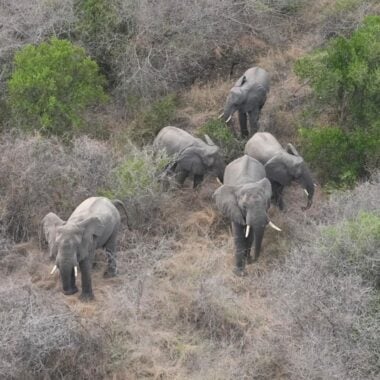
The decision, Charles explains, was driven largely by elephants. Before the expansion, roughly 600 elephants were concentrated inside Liwonde’s original boundaries, putting enormous pressure on vegetation. “If we just had the elephants concentrated in Liwonde, then with time the vegetation would suffer,” he says. “Now we’ve seen elephants moving into Mangochi Forest Reserve, and the population density is shared between the two conservation areas.”
This has given Liwonde’s habitat a chance to recover, helping restore balance across the ecosystem. Perhaps the clearest way to understand Liwonde’s transformation is to look back at what the park once was. When African Parks first became involved in 2015, infrastructure was limited, and wildlife frequently moved beyond the park boundary. According to Charles, there were only a few kilometres of functioning fence.
“People could just come in, and animals would just be everywhere,” he says.
Elephants regularly wandered into nearby villages, destroying crops and causing dangerous encounters. “People stopped farming because they felt like they were farming for the elephants to come and eat,” Charles explains.
During a recent visit to a surrounding village, a traditional leader showed him a tree scarred by an elephant encounter years earlier. “He said, ‘Before you guys came in, this happened to me,’” Charles recalls. “I don’t know how I’m alive.”
Before African Parks, human-wildlife conflict was common, and according to Charles, dozens of people had lost their lives in encounters with elephants.
The situation looks very different today. Liwonde and Mangochi are now protected by roughly 244 kilometres of perimeter fencing, alongside an additional internal elephant fence designed to reduce breakouts. Human-wildlife conflict has dropped significantly, allowing many neighbouring communities to return to farming.
“Now they can actually plant crops and harvest,” Charles says. “Something they couldn’t do back then.”
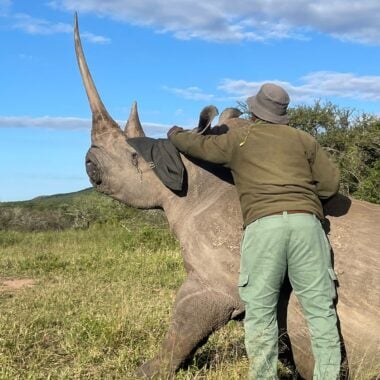
At the same time, wildlife restoration efforts have dramatically reshaped the park. Between 2016 and 2022, Liwonde saw the reintroduction of lions, cheetahs, black rhino, and African wild dogs, restoring species that had long disappeared from the landscape. But bringing animals back is only part of the challenge. Keeping them there is another story.
Wild dogs, in particular, have proven difficult. “It hasn’t been an easy process,” Charles says. The first pack, reintroduced in 2022, showed promising signs early on. Then disaster struck. “We lost a pack of over twenty dogs to a poisoning incident,” he says.
A second reintroduction followed, but new problems emerged. Some dogs were caught in snares and gin traps, forcing conservation teams to temporarily move survivors back into a holding boma while they reassessed.
Poaching remains one of the biggest ongoing pressures facing the park, particularly through wire snares. Ironically, many of those snares come from the very infrastructure designed to protect the reserve. Fence vandalism has become a major challenge, with poachers cutting fencing wire and repurposing it for traps. “Our fence line is 244 kilometres,” Charles says. “And then inside, we have another fence. There’s a lot of wire.”
To counter the problem, Liwonde launched a Community Fence Protection Initiative in late 2024, incentivising nearby communities to patrol sections of fence near their villages. “We’ve seen a drop in fence vandalism,” Charles says. “But the challenge remains.”
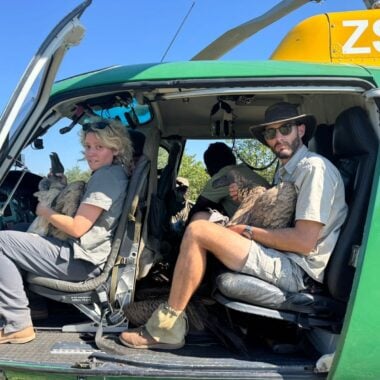
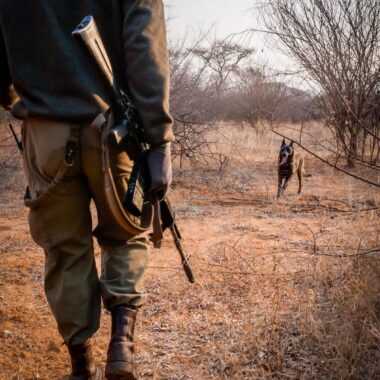
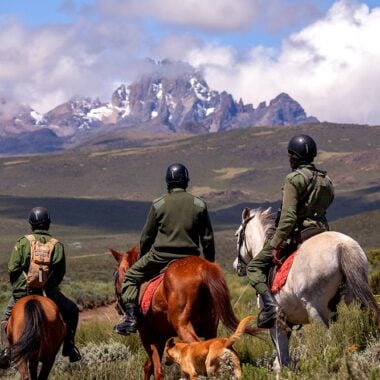
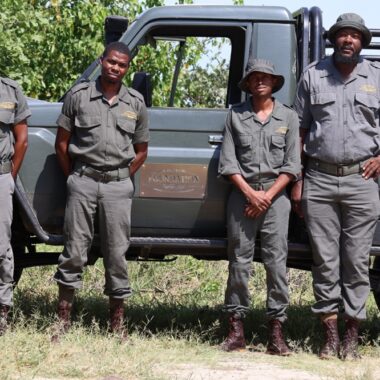
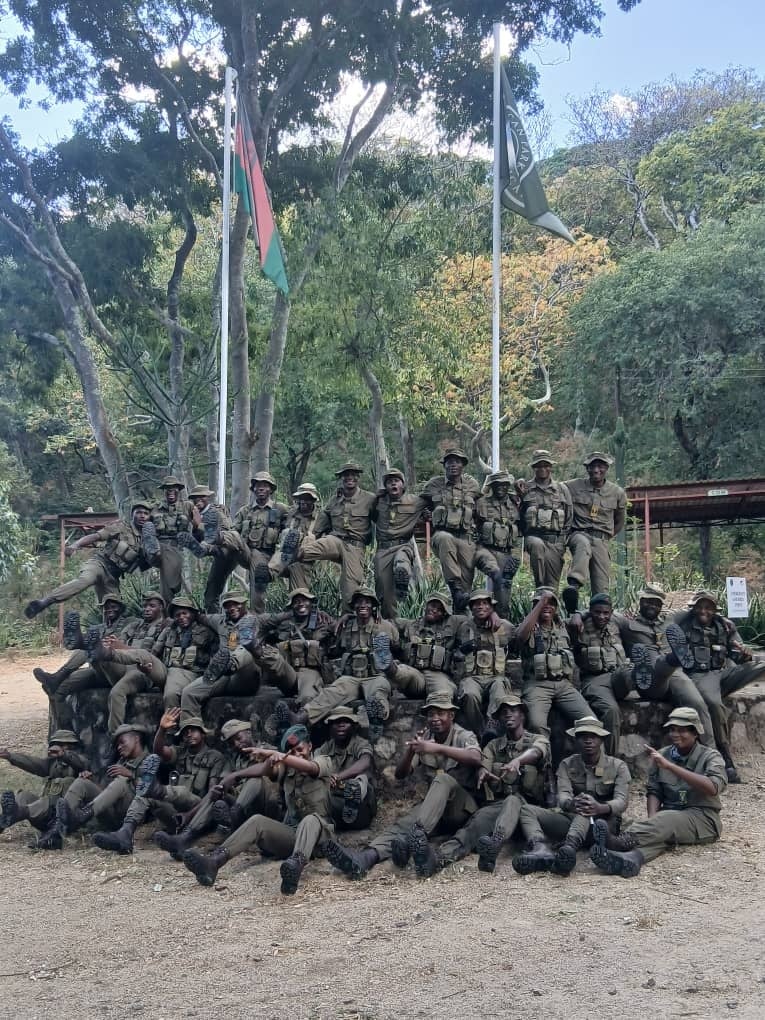
At the centre of all of this work are the park’s ranger teams. Every day, field rangers head out across Liwonde and Mangochi on a mix of terrestrial, river, and occasional aerial patrols. Water patrols move along the Shire River, Malawi’s largest river, which cuts directly through the park. Elsewhere, foot patrol teams cover vast stretches of bush, checking for signs of poaching, damaged fencing, or illegal activity. And when helicopters are available, air patrols help monitor larger sections of the landscape. But most of the work still happens on the ground.
The park’s ambitious vision is to achieve a financially stable Liwonde-Mangochi complex with diverse, intact biotic communities, including cathedral mopane, which provides benefits to supportive and engaged neighbouring communities. This is supported by a detailed planning system that maps out priorities five, ten, and even twenty years into the future. Success means thriving ecosystems and wildlife populations, and communities that see conservation as something worth protecting.
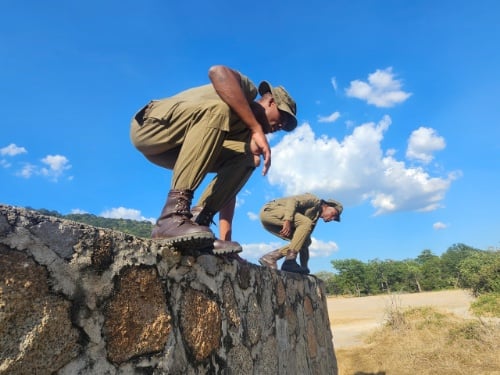
Achieving that vision also depends on the practical realities of life in the field. The terrain at Liwonde is tough, and patrols are demanding. Rangers spend long days covering ground where damaged fences, snares, or signs of poaching can appear almost anywhere.
Furthermore, the park aims to ensure that the compositional, structural and functional diversity of distinctive Liwonde-Mangochi habitats, including floodplains, cathedral mopane, miombo woodland and evergreen forest, has been restored and is maintained along with their associated fauna. Achieving this objective intensely depends on the practical realities of life in the field. The terrain at Liwonde is tough, and patrols are demanding. Rangers spend long days covering ground where damaged fences, snares, or signs of poaching can appear almost anywhere.
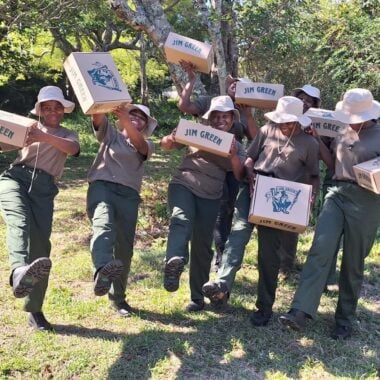
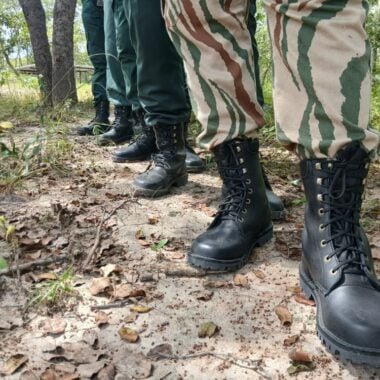
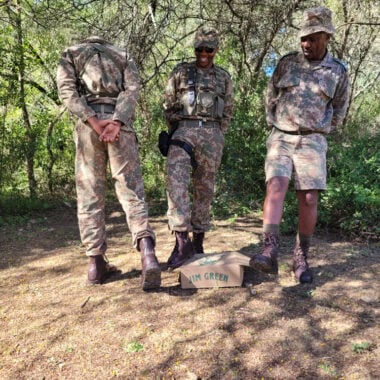
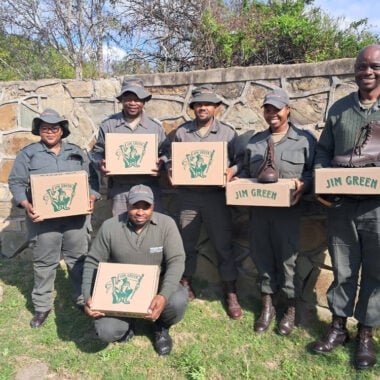
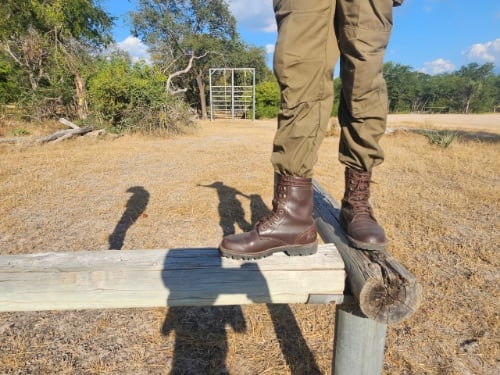
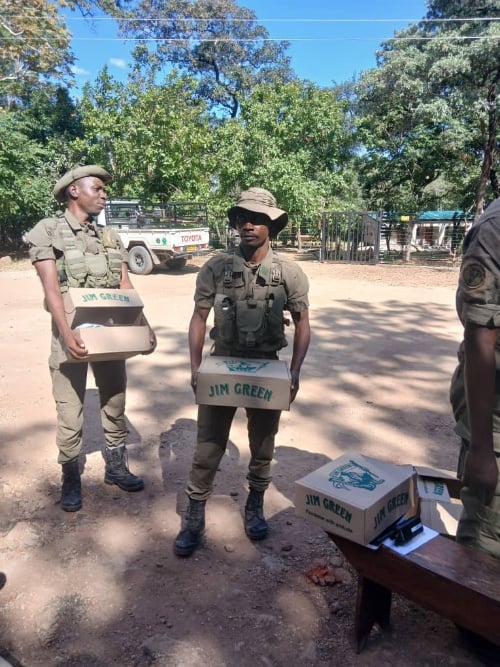
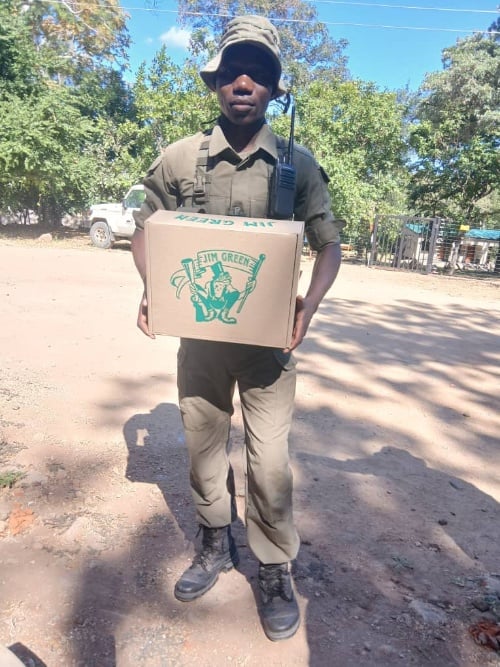
Recently, Jim Green and GRAA offered a little relief in this regard by donating boots through the Boots for Rangers initiative, something Charles says has already been hugely appreciated. “The terrain is really tough,” he says. “Those shoes can last for years.”
“Now they have one less problem,” Charles continues. “They’re not thinking about a shoe. They’re thinking about how effectively they will carry out their daily duties to support the park’s long-term conservation goals.”
Cheers,
The Jim Green Team
Through our Boots for Rangers initiative, run in partnership with the Game Rangers Association of Africa, we donate one pair of boots to a ranger for every ten pairs sold from our Ranger range. These boots support conservation teams at sites across Africa, with 8691 pairs already on the ground. As of 14/05/2026